
The complete guide
HEPASilent explained: how electrostatic filtration beats a denser HEPA filter
Air purifier marketing loves to print "99.97%" on the box and leave it there, as if every purifier hitting that number works the same way. It doesn't. The number describes what comes out the other side of the filter; it says nothing about how the air got pulled in, how fast, or how loud the process was to get there. The Blue Max 3250i is a useful case study because Blueair builds its whole pitch around a different mechanism, HEPASilent, and the differences it produces are the kind you actually notice living with the thing rather than reading about it.
What a standard HEPA filter is doing
A conventional HEPA purifier is, mechanically, simple. A fan forces air through a dense filter mat, and particles above a certain size get trapped in the fibres as the air passes. To hit a high removal rate, especially down at 0.1 microns, the filter has to be dense enough that very little slips through unfiltered. Density is the problem: dense filter media resists airflow, so the fan has to work harder to push the same volume of air through it. Work harder means more noise, and often a slower total volume of air cleaned per minute, because the fan is fighting resistance rather than just moving air.
Where HEPASilent changes the trade-off
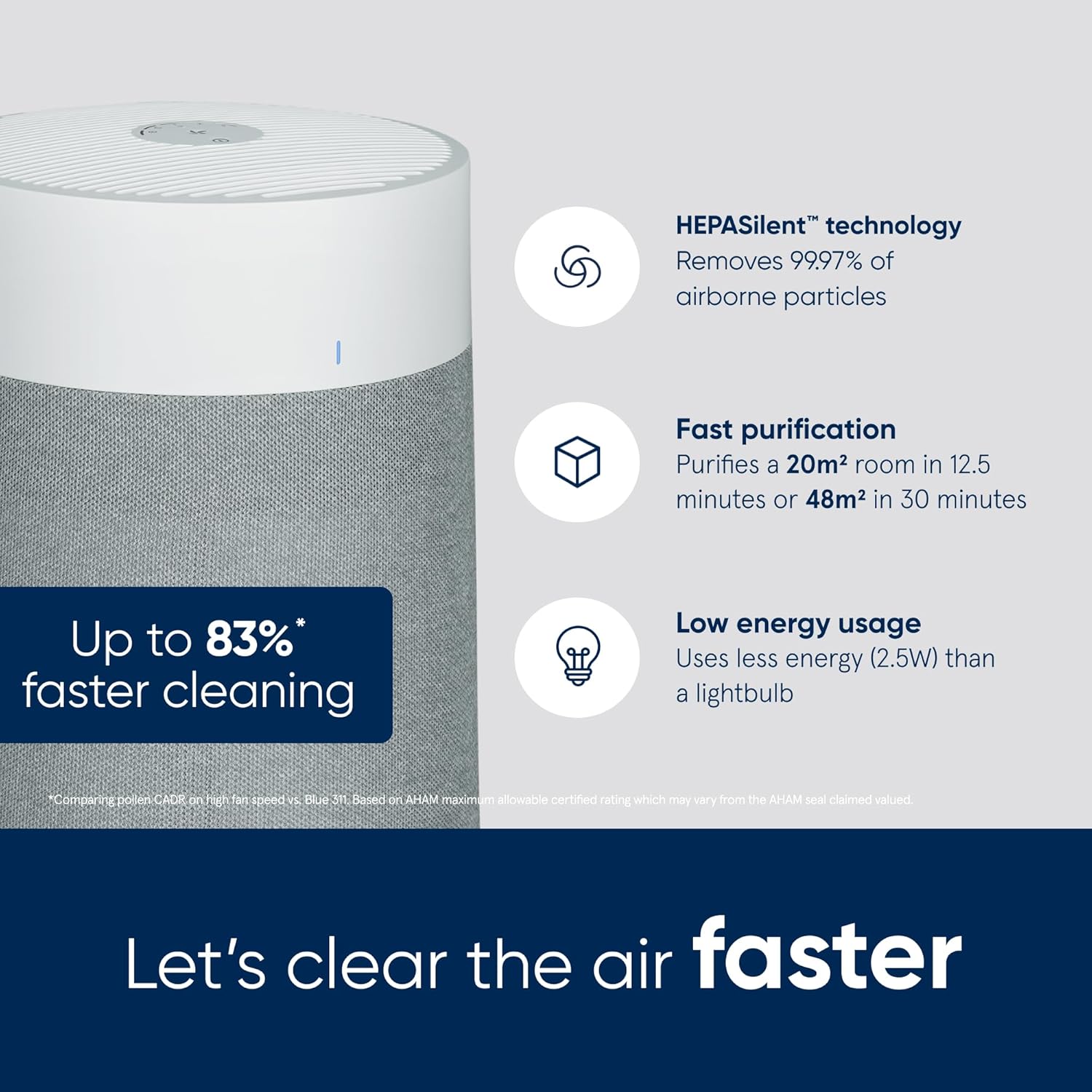
HEPASilent, the technology behind the Blue Max 3250i, adds an electrostatic charge to that basic mechanical setup. Incoming particles pick up a charge as they pass through part of the filter system, and the charge then pulls them toward the filter media rather than relying purely on physical trapping as air is forced through. That does two things at once: it lets the mechanical filter layer be less dense than a HEPA-only design would need for the same removal rate, and it means the unit isn't fighting as much resistance to move the same volume of air. Less resistance is where the quiet comes from, and it's also part of why Blueair can rate this unit to clear a 48m² room in 30 minutes without the fan screaming to do it.
The result on the box: at least 99.97% of particles removed down to 0.1 microns, the same headline number a good mechanical HEPA filter can also claim, but reached with a fan that only needs to run at 18dB on low to be effective, quiet enough to earn Quiet Mark certification, an independent check rather than a marketing line.
What this actually buys you day to day
The practical upshot is that a purifier sized for a large room stops being a purifier you only run when you're out of the room. An 18dB low setting is genuinely close to silent, so leaving it running overnight in a bedroom, or through a work call in the next room, isn't the trade-off it is with a lot of purifiers rated for spaces this size. Full mechanical HEPA units capable of clearing 48m² tend to need higher fan speeds to get there, and higher fan speeds are audible in a way that changes whether people actually leave the thing on.
The activated carbon layer sits on top of the particle filtration and handles a separate problem: odours from cooking, pets and smoking, which particle filters alone don't touch well because they're gas-phase, not solid particles. Carbon adsorbs those molecules rather than trapping them mechanically, which is why most serious air purifiers pair carbon with a particle filter rather than relying on one or the other.
Who this suits
This unit is sized for a living room, an open-plan kitchen-diner, or a larger bedroom, not a desk or a box room; Blueair's own coverage figures put it at up to 48m². If your actual space is smaller, closer to 15 or 20m², you'd get faster clean-air turnover from this unit than you need, and a smaller model in the same HEPASilent family would do the job with a smaller footprint and cost. Where it earns its size is in shared living spaces: households managing hay fever across a whole floor, a kitchen that generates cooking odours the rest of the house notices, or anyone who wants one purifier doing the work of what would otherwise be two smaller units in two rooms.
The smart WiFi control on this model also matters more in a larger, shared space, where you're more likely to want to check or adjust the unit without walking over to it, particularly if it's tucked into a corner of an open-plan room rather than sat on a bedside table.
Living with it and keeping it working
HEPASilent filtration still depends on the same basic maintenance any filtration system needs: keep the casing and intake vents clear of dust build-up, and replace the filter combination on the schedule Blueair sets out for this model. A clogged filter loses both the electrostatic effect and the mechanical trapping that make the low-noise numbers possible, so skipping replacement doesn't just reduce filtration, it also pushes the fan back toward working harder and getting louder to compensate, undoing the main reason to choose this technology in the first place.
The short version
HEPASilent isn't a different destination from standard HEPA, it's a different route there: an electrostatic charge does part of the work a denser filter and a harder-working fan would otherwise have to do alone. On the Blue Max 3250i that shows up as a purifier rated for a genuinely large room, 48m², that can still run at 18dB on low and hold Quiet Mark certification. If your space is open-plan or larger than a single small bedroom, that combination of coverage and quiet is the reason to look at this model over a smaller HEPA-only unit.