
The complete guide
360° intake vs front-intake air purifiers: does surround airflow actually clean a room faster?
Most people shopping for a bedroom air purifier compare the same two or three numbers: CADR, room size, noise level. Fewer stop to ask how the machine actually pulls air in, and that detail changes how evenly a room gets cleaned. The OUNEDA HY1800 Pro is built around a 360° surround air inlet rather than the single front grille you'll find on most purifiers in this price range, so it's worth working out what that design choice actually buys you.
How front-intake purifiers work, and where they fall short
A typical air purifier pulls air in through one face, usually the front or a lower grille, pushes it through a filter stack, and blows it back out the top or the opposite side. That works fine if you sit the unit in an open spot with airflow reaching it from all directions. In a real bedroom, though, purifiers usually end up against a wall, in a corner, or beside a nightstand, all positions that partially block one or more sides of the intake.
The practical effect is a purifier that cleans strongest in a cone directly in front of it and weaker at the edges of the room. Air near the far corners, behind furniture, or on the other side of the bed takes longer to cycle through the filter, simply because the machine has to pull it across the room to reach the intake first.
What 360° intake changes
The HY1800 Pro draws air in from all sides at once instead of relying on one face. In a room where the unit sits against a wall, that still leaves three working sides pulling air in, rather than one. The result is less dependence on exact placement: you don't have to find the one spot in the room where the intake has a clear line to every corner, because it's drawing from multiple directions regardless of where you put it.
This matters more in smaller, furniture-dense rooms than in large open spaces. A 215 sq ft bedroom with a bed, wardrobe and desk has plenty of obstacles between any single-intake purifier and the far corners. A 360° design shortens the average distance any given pocket of air has to travel before being pulled in, which is part of why OUNEDA rates the HY1800 Pro at refreshing the air roughly 5 times an hour in that size room.
The filtration doing the actual cleaning
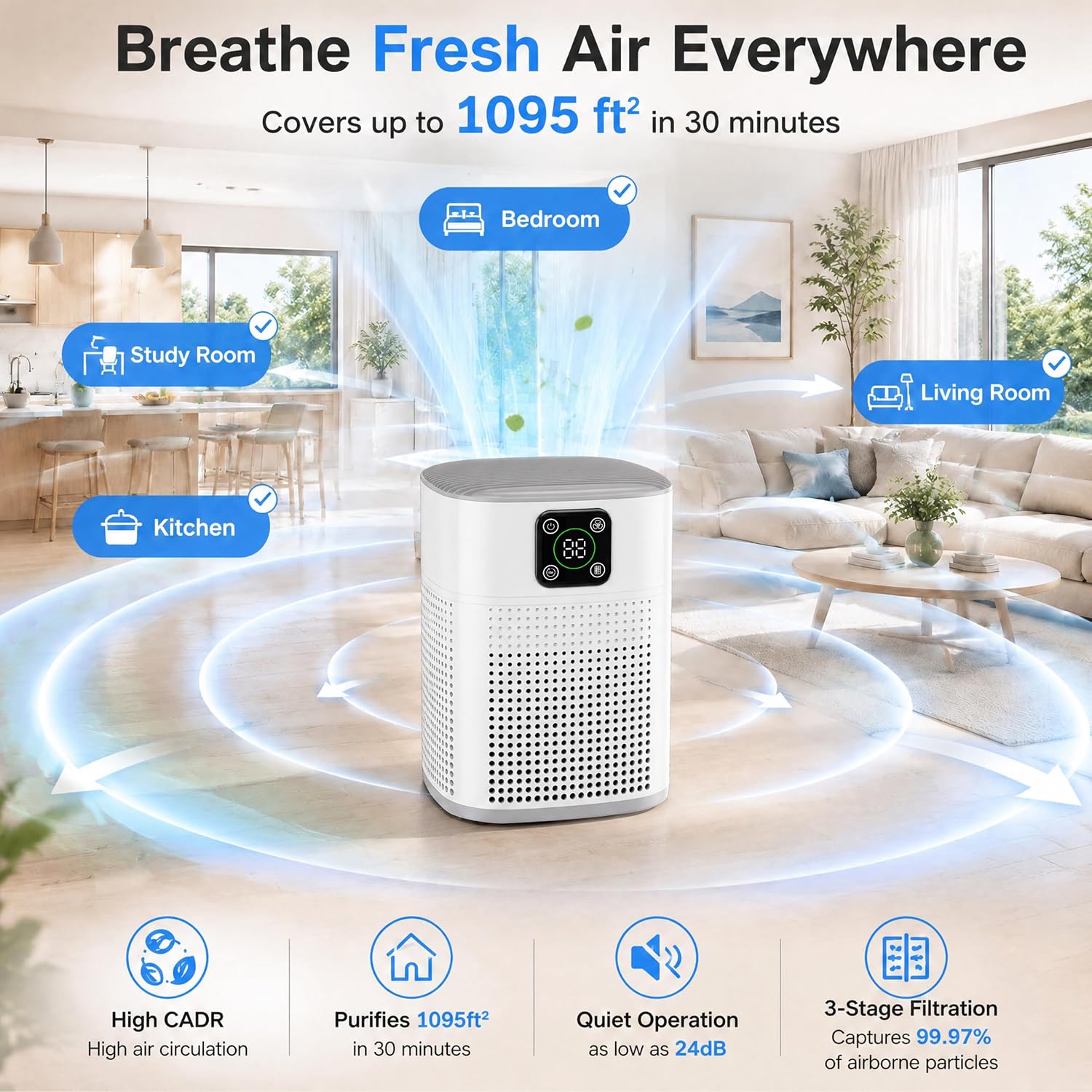
Airflow design only matters if what comes out the other side is genuinely cleaner, and that's down to the H13 True HEPA 3-stage filter. It's rated to capture at least 99.97% of airborne pollutants, the same benchmark used for medical-grade HEPA filtration, covering smoke particles, pet dander, hair and general household dust. The 360° intake feeds air into this filter faster and from more directions, but the filter itself is what determines how clean the output actually is.
For anyone dealing with a specific problem, a shedding pet, a smoker in the house, dust in an older building, this is the part of the spec sheet that matters most. The intake design improves how quickly the room gets covered; the HEPA stage is what removes the particles once they're pulled in.
Who this suits
The HY1800 Pro is sized and priced for a single room rather than a whole house: bedrooms, nurseries, home offices, kitchens or a room shared with a pet. Its 215 sq ft rating covers most UK bedrooms with margin, and the 24dB sleep mode means it can run overnight without becoming background noise that keeps you up. If you're trying to cover an open-plan living and kitchen space, or a room considerably larger than 215 sq ft, you'd want to check coverage on a larger unit instead, since the intake design doesn't change the underlying room-size math.
It also suits anyone who's tried a purifier before and found it seemed to clean one side of the room while the other stayed stuffy. That's the exact symptom a 360° intake is designed to fix, so if that's been your experience, this is a meaningful upgrade rather than a marginal one.
Choosing where to put it
Even with 360° intake, placement still matters a little. Give the unit a small amount of clearance on at least two or three sides rather than wedging it into a fully enclosed alcove, since even a surround intake needs air to actually reach it. A nightstand, a low shelf, or open floor space near the foot of the bed all work. Avoid pushing it flush into a corner with furniture on both remaining sides, as that reintroduces the same blocked-airflow problem a 360° design is meant to avoid.
Living with it day to day
The controls are deliberately simple: three fan speeds and a sleep mode, nine timer options, and an LCD display that also tells you when the filter needs attention. Run it on a higher speed after cooking, cleaning, or a visit from a shedding dog, then drop to sleep mode overnight. At 12W, cost isn't a reason to switch it off during the day either, OUNEDA's own estimate puts full-time running under $10 a year in electricity.
Maintenance is light: swap the HEPA filter every 3 to 6 months, guided by the reminder light rather than guesswork, and wipe the casing down with a dry cloth occasionally. There's no water reservoir, no complicated disassembly, and no app to configure.
The short version
A 360° air intake doesn't change how good the filter is, it changes how quickly and evenly the room around the purifier gets pulled through that filter. In a furniture-filled bedroom where a front-intake unit would otherwise clean unevenly, that's a real, practical advantage rather than a marketing line. Pair that with H13 True HEPA filtration rated at 99.97% capture, a 24dB sleep mode, and a 215 sq ft coverage rating, and the HY1800 Pro is built specifically for the room where most people actually want cleaner air most: the one they sleep in.