
The complete guide
How laser particle sensors and Auto Mode take the guesswork out of the Levoit Core 300S
Buying an air purifier usually means guessing: is the air bad enough right now to run it on High, or is Low fine? The Levoit Core 300S is built to remove that guess. It carries a PM2.5 laser sensor that reads the air continuously and an Auto Mode that acts on the reading without you touching a button. This guide looks at what that sensor and mode actually do, and how to decide if that is worth paying for over a purely manual model.
What a PM2.5 sensor is actually measuring
PM2.5 refers to particulate matter smaller than 2.5 microns, small enough to stay suspended in air and get drawn deep into the lungs when inhaled. It is one of the more commonly tracked indoor and outdoor air quality metrics because it correlates closely with pollution sources: traffic, smoke, cooking, and fine household dust all contribute to it.
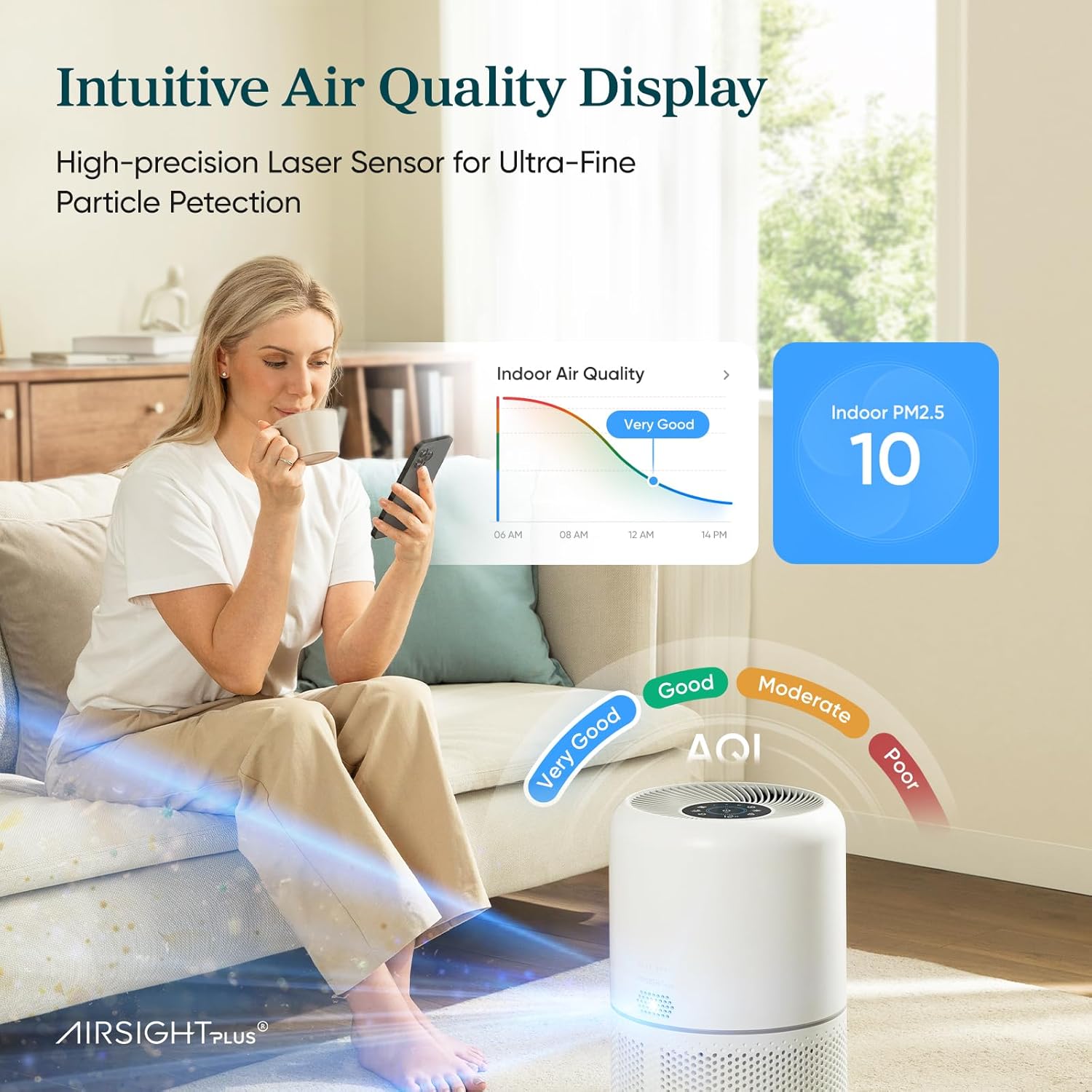
The Core 300S's laser sensor measures this in real time and shows a reading on the unit's own display, as well as in the VeSync app if you want to check it remotely. That is a meaningful difference from an air purifier with no sensor at all, where you are left judging air quality by smell, visible dust, or simply trusting that a fixed fan speed is doing enough.
Auto Mode, and why it matters more than it sounds
Auto Mode takes that sensor reading and turns it into a decision: raise fan speed when the air gets worse, ease off once it improves. On paper this sounds like a minor convenience feature. In practice, it changes how the unit behaves across a normal day. Cooking, opening a window, a burst of pollen coming in, or simply more people in the room, all shift particulate levels, and a fixed-speed purifier either over-runs constantly on High or under-reacts on a lower setting.
With Auto Mode switched on, the unit tracks those swings without needing you to notice them yourself. That is particularly useful overnight or while you are out of the room, periods when nobody is around to bump the fan speed up manually even if the air quality genuinely calls for it.
Coverage: what 108m² and a CADR of 258m³/h buy you
The Core 300S is rated at a CADR of 258m³/h, which Levoit translates into covering up to 108m² once an hour, or 54m² twice an hour, using 360° air circulation. That is meaningfully more than the standard Core 300's 80m² rating, and pushes the 300S into genuinely usable territory for an open-plan living and dining space, not just a single bedroom.
The higher-speed fan setting is also positioned by Levoit as useful for general airflow and a cooling effect in warmer months, on top of its filtration job, worth knowing if you are deciding between models partly on versatility.
Filtration underneath the smarts
Strip away the sensor and the app, and the filtration itself works the same way as the rest of the Core range: three-stage HEPA filtration rated to capture pollen, dust, pet dander, mould and smoke particles down to 0.3 microns. During hay fever season that matters in a very direct way, since the sensor and Auto Mode mean the fan responds as pollen levels shift through the day rather than running at a single fixed speed regardless of conditions.
Levoit also offers the same four filter variants across the Core range for the 300S, Original, Pet Allergy, Toxin Absorber and Mould, so the cartridge can still be matched to whichever pollutant is the priority in your home, independent of the smart features layered on top.
Do you actually need the app?
The VeSync app adds remote monitoring and control, useful if you want to check air quality while you are out, or adjust settings without walking over to the unit. It is not required for Auto Mode or the sensor to function, both work locally on the machine. If remote access is not something you will actually use, the value of the 300S over a simpler model comes down mostly to the sensor and Auto Mode themselves, not the app layer.
The short version
The Core 300S adds a real-time PM2.5 sensor and an Auto Mode that adjusts fan speed based on what that sensor detects, on top of the same three-stage HEPA filtration used across the Core range. Coverage is rated at 108m² with a CADR of 258m³/h. If you want visibility into your actual air quality and a unit that reacts to it without input, that is what you are paying the difference for over a manual model.