
The complete guide
Getting ahead of allergy season: coverage and speed matter more than specs alone
Allergy season does not wait for you to notice the air is bad; by the time your eyes are itching or your nose is running, pollen has already been settling into the room for hours. The Philips 1000i Series AC1715 is built for that timing problem specifically, with enough speed and coverage to get ahead of a pollen count rather than reacting to it. This guide looks at why speed and room size matter as much as filtration grade when you're choosing a purifier for allergy season.
Why speed matters more than people think
Most purifiers are compared on their filtration rating, the percentage of particles removed. That number matters, but it only tells you how clean the air becomes once the purifier has actually processed it. During allergy season, pollen is arriving continuously: on clothes, through doors, on pets coming in from the garden. A purifier that filters well but processes air slowly is constantly playing catch-up.
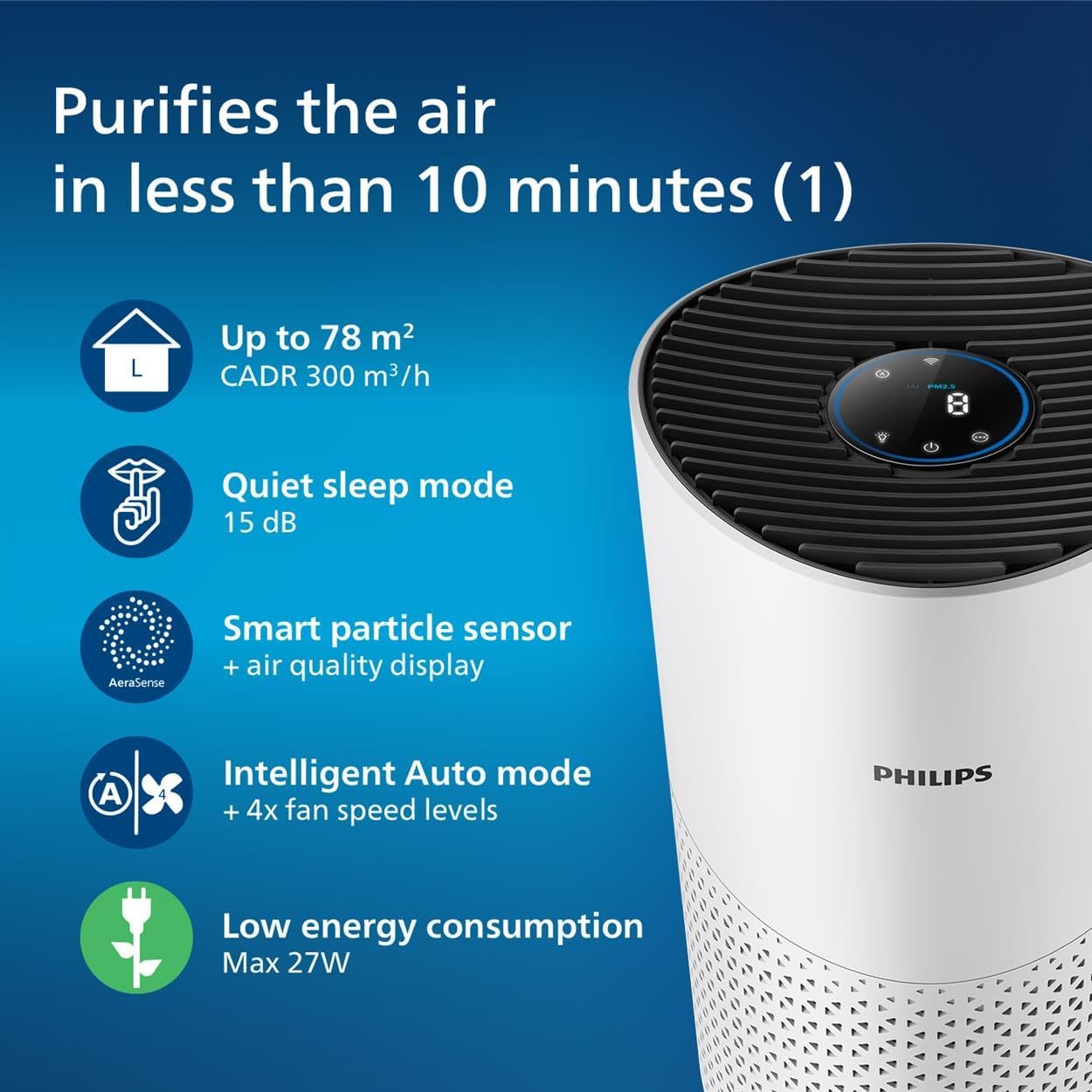
This is where CADR (Clean Air Delivery Rate) becomes the more useful number for allergy sufferers. The 1000i Series is rated at 300 m3/h, which Philips translates into clearing a 20m² room in under 10 minutes at full speed. That speed means a fresh burst of pollen, someone walking in from the garden, a window opened briefly, gets processed and removed quickly rather than lingering in the room air for the next hour.
Coverage: matching the purifier to the room, not just the season
The 1000i is rated for rooms up to 78m², which puts it toward the larger end of what a single purifier can realistically handle. Undersizing a purifier for allergy season is a common mistake: a compact unit rated for a bedroom will genuinely struggle in an open-plan living room, however good its filtration percentage looks on paper. Matching CADR and coverage to the actual room size is what turns a good filtration rating into a noticeable difference in how a room feels.
What the ECARF certification actually confirms
Percentage particle-removal figures are useful but generic; they do not tell you specifically how a purifier performs against the substances that trigger allergies. ECARF certification is more specific: it confirms 99.99% removal of pollen, dust mite and pet allergen particles specifically, verified by an independent allergy-focused body rather than a general lab test. For someone shopping specifically because of hay fever or a dust mite sensitivity, that is the figure worth checking, more than the headline particle-removal percentage alone.
Setting it up for allergy season
Run the purifier continuously through the peak of pollen season rather than switching it on only when symptoms flare; airborne pollen levels build up between uses, and a purifier that has been running steadily keeps the baseline lower. Keep windows closed while it runs where practical, since an open window continuously reintroduces outdoor pollen faster than the purifier can remove it, and ventilate in short bursts instead.
Placement matters too: give the unit clear space so air can circulate through it properly, ideally somewhere central to the room rather than tucked in a corner behind furniture. If you can, run it in the room you spend the most waking time in during the day and switch to a bedroom overnight, using the quiet 15dB sleep mode so it does not disturb rest.
Keeping performance up through the season
A HEPA filter loaded with a season's worth of pollen will not perform at its rated level indefinitely. Check the display or Air+ app for filter status through the season, since heavy pollen periods will use up filter capacity faster than a typical month. Replacing on the purifier's own indicated schedule, rather than a fixed once-a-year guess, keeps the allergen-removal performance closer to its certified figure for longer.
Who this suits
This model suits anyone managing a larger room during allergy season: a family living room where everyone tracks pollen in, an open-plan kitchen-diner, or a bigger bedroom for someone whose hay fever badly disrupts sleep. It is less necessary for a small, easily-covered room, where a more compact purifier would do the job at lower cost.
The short version
Filtration percentage tells you how clean the air gets; CADR and coverage tell you how fast and how far that reach extends, and during allergy season, that speed is what keeps pollen from settling in the first place. Match the room size honestly, run it continuously through the peak weeks, and let the ECARF-certified filtration and the filter status indicator do the rest.